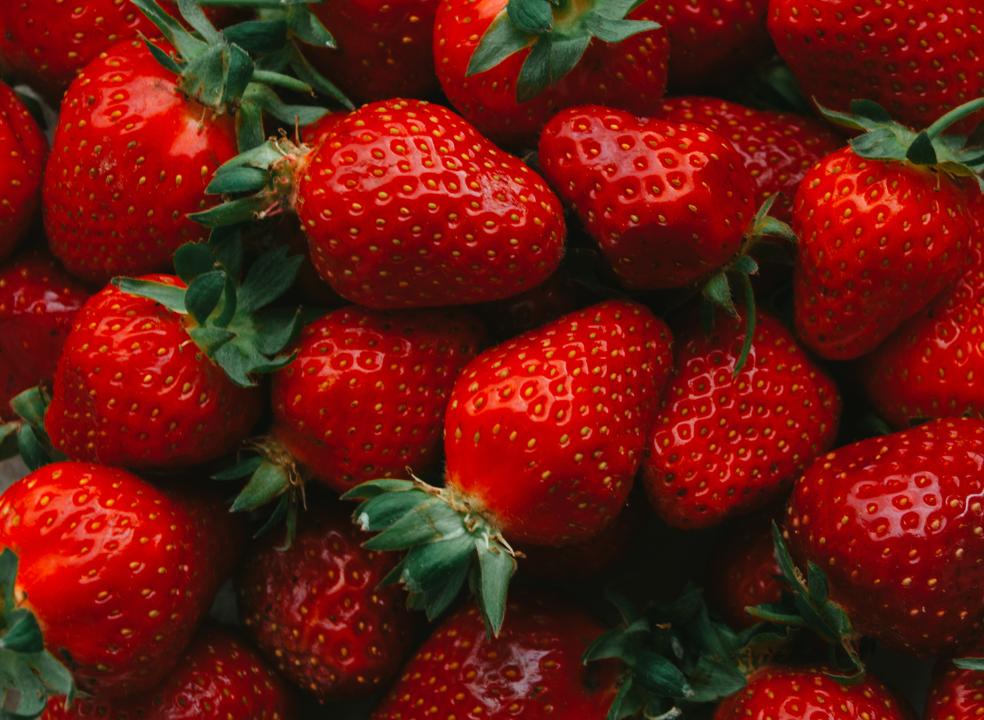
A few weeks ago, I went strawberry picking for the first time in several years.
We went with another family and their children to a local strawberry field near the end of the season. We could still find strawberries, but you could tell the season was winding down. Many berries were already soft. More often than not you would grab a nice looking strawberry and it would be mouldy on the other side, leaving an unpleasant strawberry goo on your hand. Finding good strawberries definitely took a bit more searching than it would have a few weeks earlier.
What caught my attention though were the unusual looking strawberries.
One looked almost like a little spaceship. Another seemed to be three strawberries that had somehow agreed to become a single fruit. They were exactly the kind of strawberries you would never see in a supermarket.
The adults were picking and the children were busy helping sort the strawberries into the baskets, deciding which berries made the cut to come home with us.
Later on that day, I found myself thinking about something: Strawberries aren’t actually difficult to find. So why is strawberry season so exciting?
Where I live, as with many places around the world, you can buy fresh strawberries pretty much any time of year. Frozen strawberries are always available. If I suddenly decide I need strawberries in February, there is a good chance I can find some.
Yet strawberry season still feels different.
Roadside stands appear. Bakeries are full of strawberry cake. People start talking about which fields are open, which ones have the “best” berries. For a few weeks, strawberries seem to become more than just another fruit.
So if strawberries are already available year-round, why does strawberry season still matter?
You can buy strawberries all year. That’s not quite the same thing.
Part of the answer is that local strawberries in season often do taste different.
Some of that comes down to biology.
Strawberries are a delicate fruit. Unlike bananas, they don’t continue developing flavour after harvest in quite the same way. A strawberry picked early enough to comfortably survive a long journey through harvesting, transportation, storage, and retail display is often not the same strawberry you would have picked for flavour alone. If you’ve ever bought strawberries off-season, you will know what I mean. Not so sweet. Maybe a bit sour. Firmer texture even.
Fresh fruit supply chains are a constant balancing act.
Growers and retailers are trying to optimize several things at once: flavour, shelf life, transportability, appearance, and food waste. A perfectly ripe strawberry may taste wonderful, but it is also softer, more fragile, and much harder to move through a supply chain without damage. What was a delicious strawberry, will probably end up as a moldy squished red blog upon arrival.
Then there is temperature.
A strawberry picked and eaten immediately from the plant, still slightly warm from the afternoon sun, can taste wildly different from one taken straight from the refrigerator. In general, temperatures tend to suppress both sweetness and aroma perception. It’s one reason many foods taste more flavorful as they warm up. (And also why ice cream or soda tastes a lot sweeter once a bit warm.)
The fruit itself may not have changed very much.
The experience has.
Flavour isn’t only inside the strawberry
One of the things sensory scientists learn in the food industry very quickly is that flavour doesn’t simply live inside food.
Flavour is created by an interaction between the product, the person eating it, and the surrounding context.
Researchers have repeatedly shown that identical foods can be experienced differently depending on the information people receive beforehand. The same product may be rated differently if consumers believe it is local, organic, premium, or produced in a particular region.
The food itself hasn’t changed.
The expectations have.
I suspect the first local strawberries of the season benefit from both effects.
They may genuinely be fresher and more flavorful. But they also arrive after months of access only to strawberries that were frozen or transported long distances.
You’ve been waiting for them, even if only subconsciously.
The experience starts long before the first bite.
Sometimes the biggest change is what we’re paying attention to
In some places, strawberry season also changes something beyond flavour.
It changes attention.
For a few weeks, strawberries become unusually visible, especially in Germany where I live. Festivals, new products in bakeries, helm the roadside stands. Strawberries move from the background into the foreground.
The same thing happens with other food topics.
Take local food.
Discussions about food miles, local sourcing, and resilient supply chains have existed for years. For a long time, they were often seen as topics for sustainability enthusiasts, farmers’ market regulars, or people who spent far more time than average thinking about food systems.
Then the pandemic disrupted global supply chains. Not to mention the increase in energy prices following the war in Ukraine.
Suddenly many more people were asking where their food came from, how far it had travelled, and how dependent we had become on long and complicated supply chains.
The issues themselves weren’t new.
The attention was.
Sometimes the biggest shift isn’t in the thing itself.
It’s in how many people are paying attention to it at the same time.
Strawberry season works in much the same way. For a few weeks, an entire community seems to notice the same fruit.
Strawberry season is about more than strawberries
I’m not saying that I’d want to go back to a world where many foods simply disappeared for months at a time.
Modern food systems have achieved something quite amazing. They allow us to eat foods that would once have been seasonal luxuries and to enjoy a vast variety of products throughout the year.
But they’re much better at delivering products than delivering everything that surrounds those products.
The same distinction shows up well beyond food. We often focus on delivering the product, the service, or the technology itself. But people rarely experience those things in isolation. They experience the expectations, the timing, the communication, and the context surrounding them.
The strawberries available in January may satisfy a craving. Enable you to make that one dessert recipe you wanted to try out. Frozen strawberries also make quite delicious smoothies. And yes, imported strawberries can still be enjoyable.
But they don’t usually arrive with the same anticipation.
The experience is different.
And I would say, that’s why strawberry season still feels special, even in a world where strawberries are rarely completely absent.
The strawberries I still remember
The strawberries I remember most from that afternoon weren’t the biggest or the prettiest.
They were the strange ones.
The little spaceship. The tripod. The strawberries that ignored the supermarket rules for how they are supposed to be formed.
Those were the strawberries that were memorable.
Because they belonged to that particular afternoon, at that particular point in the season, surrounded by family, friends, and a field that was already past it’s peak for the season.
You can buy strawberries at almost any time of year.
Strawberry season is a little harder to bring home in a basket.
Leave a Reply